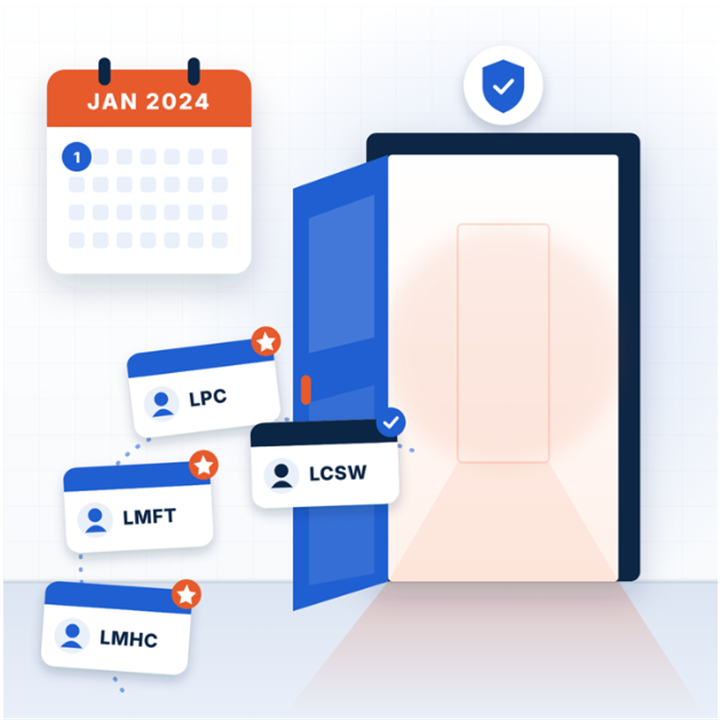
A patient turns 65 and asks whether you can keep seeing them on Medicare. Many answers online still say only social workers qualify, because they were written before 2024. So can an LCSW bill Medicare, and where do LMFTs and licensed counselors stand now? The answer turns on which licenses Medicare pays, on what terms, and in which settings it stops paying you directly.
Which therapists Medicare pays directly, and since when
Medicare pays 3 categories of therapist directly: clinical social workers, marriage and family therapists and mental health counselors. Together they cover the 4 licenses in the question. Each can bill for services to diagnose and treat mental illness that their state license allows.
What changed in January 2024
Section 4121 of the Consolidated Appropriations Act, 2023 created the marriage and family therapist and mental health counselor categories. Payment began on January 1, 2024. Medicare does not pay these therapists for services before that date, according to CMS’s enrollment FAQs.
Licensed clinical social workers (LCSWs)
Yes, an LCSW can bill Medicare Part B directly under the clinical social worker benefit in 42 CFR 410.73, which predates the 2024 change. CMS’s Medicare and Mental Health Coverage booklet lists clinical social workers among the professionals Part B pays for mental health care.
Licensed marriage and family therapists (LMFTs)
Yes, since January 1, 2024, an LMFT can enroll in Medicare and bill independently under 42 CFR 410.53. MFT and MHC services are also covered in rural health clinics and federally qualified health centers, where the clinic bills for them, CMS says.
Licensed professional counselors and mental health counselors (LPCs and LMHCs)
Yes, LPCs and LMHCs bill Medicare as mental health counselors under 42 CFR 410.54, also since January 1, 2024. The category accepts several state titles: mental health counselor, clinical professional counselor, professional counselor, and addiction or alcohol and drug counselor. A counselor licensed under another state title can still enroll as one if they meet every requirement, CMS says.
Medicare Part B
All four licenses can bill Medicare on their own
Each needs a state license and Medicare enrollment, and must accept assignment.
Master’s or doctorate2 years or 3,000 hours supervisedNo independent billing for hospital inpatients
What Medicare checks before it pays a therapist
Medicare checks 3 things for every license: a qualifying master’s or doctoral degree, supervised post-degree experience and a current state license. LCSWs need 2 years of supervised clinical social work; MFTs and counselors need 2 years or 3,000 hours. The license must be valid in the state where the patient is seen.
Enrollment is a separate step
A National Provider Identifier from NPPES does not enroll you in Medicare. Enrollment runs through PECOS or the paper CMS-855I, and your Medicare contractor verifies the license and supervised hours before claims pay. The order and the forms are set out in Medicare PECOS enrollment, step by step. For whether claims can go out while the application is pending, see billing before your Medicare enrollment is approved.
Seeing Medicare patients without enrolling
A therapist who treats Medicare patients without billing Medicare must opt out. They then sign a private contract with each of those patients. A therapist who sees no Medicare patients needs to do neither.
One extra rule for LCSWs
Unless the patient’s doctor made the referral, an LCSW must offer to consult the patient’s primary care or attending physician, under 42 CFR 410.73(c). If the patient agrees, the consultation or the failed attempt goes in the medical record.
Medicare enrollment does not put you on any commercial panel; each insurer runs its own application, covered in insurance credentialing for therapists.
How Medicare pays an LCSW, LMFT or LPC: the 75% rate
Medicare sets the fee schedule for clinical social workers, marriage and family therapists and mental health counselors at 75% of the clinical psychologist amount. The rule, in 42 CFR 414.53, applies to all 3 categories and follows the Physician Fee Schedule. After the patient meets the Part B deductible, they owe 20% of the Medicare-approved amount, according to Medicare.gov. Medicare pays the rest.
Assignment is not optional
All three must accept assignment, which makes Medicare’s approved amount the full fee for the visit. You cannot bill the patient beyond their deductible and coinsurance. How this differs from other practitioners is covered in par vs non-par Medicare providers.
No one bills incident to these therapists
Medicare does not pay for services billed incident to an LCSW, LMFT or counselor, so a supervisee’s sessions cannot run under their number.
Medical billing from Northgate Billing submits Medicare claims for LCSWs, LMFTs and mental health counselors under the therapist’s or the group’s enrollment. The work happens inside the practice’s own software.
Scroll the table sideways to compare all three licenses.
| Rule | LCSW | LMFT | LPC / LMHC |
|---|---|---|---|
| Medicare category | Clinical social worker | Marriage and family therapist | Mental health counselor |
| Regulation | 42 CFR 410.73 | 42 CFR 410.53 | 42 CFR 410.54 |
| Billing independently since | Before 2024 | January 1, 2024 | January 1, 2024 |
| Degree | Master’s or doctorate in social work | Master’s or doctorate qualifying for MFT licensure | Master’s or doctorate qualifying for counselor licensure |
| Supervised experience | 2 years of supervised clinical social work | 2 years or 3,000 hours post-master’s | 2 years or 3,000 hours post-master’s |
| State license titles accepted | Clinical social worker | Marriage and family therapist | Mental health counselor, clinical professional counselor, professional counselor, addiction or alcohol and drug counselor |
| Payment and assignment | 75% of the clinical psychologist amount; assignment required | 75%; assignment required | 75%; assignment required |
| Hospital settings | Not billable for inpatients, or for PHP or IOP at a hospital outpatient department or CMHC | Same as LCSW | Same as LCSW |
| SNF patients | Not billable for SNF inpatients | Billable, outside consolidated billing | Billable, outside consolidated billing |
Where Medicare won’t pay you directly: settings that change the answer
No LCSW, LMFT or counselor can bill Medicare independently for a hospital inpatient. The regulations for all 3 categories exclude services to inpatients of a Medicare-participating hospital.
Skilled nursing facilities
MFT and MHC services to SNF residents are excluded from consolidated billing. These therapists bill Part B themselves and add the SNF’s Medicare provider number to the claim. LCSW services to SNF inpatients are not clinical social worker services for Part B billing.
Hospital programs
Some programs fall outside these categories. Medicare does not pay partial hospitalization or intensive outpatient services from a hospital outpatient department or community mental health center under them. They are paid as part of the program.
Dialysis facilities
LCSW services that a Medicare dialysis facility must provide under its conditions for coverage are not billable as clinical social worker services.
Telehealth
Telehealth does not change eligibility: Medicare covers mental health telehealth to patients at home on a permanent basis, according to CMS’s mental health coverage booklet.
Conclusion: which therapists can bill Medicare, and what comes next
All 4 licenses qualify, so the real decision is whether enrolling pays off for your practice. A practice with few patients over 65 may find the rate and the paperwork do not.
For practices that do take Medicare, insurance credentialing services handle the enrollment, and mental health and behavioral health billing covers the claims that follow. Northgate Billing signs a Business Associate Agreement under 45 CFR 164.504(e) before it enrolls a therapist in PECOS or opens a patient record. Once Medicare is on the list, the next question is which insurance panels to join first.
Frequently asked questions
Can 90837 be billed to Medicare?
Yes. CPT 90837 is on CMS’s list of commonly used psychotherapy codes, and Medicare covers it in person and by telehealth. LCSWs, LMFTs and mental health counselors can all bill it under their own enrollment. Each is paid for it at the same share of the psychologist amount that applies to their other covered services.
What can an LCSW bill for?
Medicare pays an LCSW for diagnosing and treating mental illness within the scope of their state license. That includes individual, family, group and crisis psychotherapy, psychiatric diagnostic evaluation, health behavior assessment and intervention, and behavioral health integration. Since 2024, LMFTs and mental health counselors bill within the same scope.
Who can bill Medicare for mental health services?
Medicare Part B pays a range of professionals for mental health care. They include physicians, clinical psychologists, clinical social workers, nurse practitioners, clinical nurse specialists, physician assistants and certified nurse-midwives. Marriage and family therapists and mental health counselors joined the list on January 1, 2024.
Can you bill Medicare yourself?
Yes. Once enrolled, an LCSW, LMFT or mental health counselor can submit claims under their own NPI. Claims go electronically, or on a paper CMS-1500 where Medicare allows it. A therapist in a group can instead reassign payment so the group bills for them. Medicare also expects an enrolled therapist to submit a claim for every Medicare patient they treat, rather than charging the patient directly.
Does Medicare require credentialing?
Yes, though Medicare calls it enrollment rather than credentialing. Credentialing usually means a commercial insurer reviewing you for its network; Medicare enrollment instead confirms you meet its license and supervised-hours rules. Claims from a therapist who is not enrolled are not paid. The same process applies to LCSWs, LMFTs and mental health counselors.
Why don’t therapists accept Medicare?
Common reasons are the rate, the rules and the paperwork. Medicare pays these therapists less than a psychologist for the same service, assignment caps what they can collect, and enrollment and documentation take time. Some opt out instead. The trade-offs are the same for LCSWs, LMFTs and mental health counselors, so each practice weighs them against its own caseload.
Can a pre-licensed therapist bill Medicare?
No. Medicare requires a full state license plus supervised post-degree experience: 2 years for LCSWs, or 2 years or 3,000 hours for MFTs and counselors. Associates and interns therefore cannot enroll in any of the 3 categories. The supervised hours must be complete, and documented if the state license does not already prove them, before the Medicare application goes in.